Guide
Rubber Coated Kettlebells: Are They Worth It?
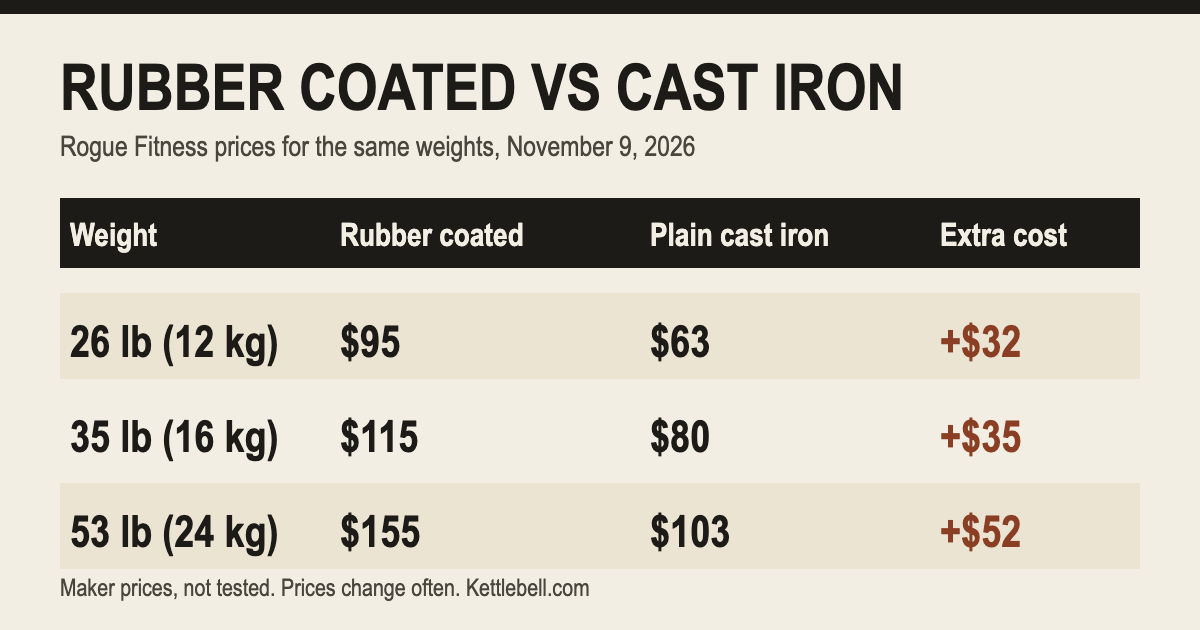
A rubber coated kettlebell is a cast iron bell with a rubber or urethane layer around the body, sold mainly to cut scuffs and chips on the bell. On Rogue’s prices a rubber coated 35 lb bell costs $115 against $80 for its plain cast iron one, so the coating adds about $35. We found no independent test of floor damage or noise, so those points are the sellers’ own. This is general information, not medical advice.
Quick answer: choose a rubber coated bell if you want the bell itself to stay unchipped and you accept paying more: on Rogue’s prices about 45 to 50 percent more per bell, though cheaper rubber coated bells exist. Do not count on it to protect your floor: the maker we read makes no floor claim, and a mat is still the usual advice (see kettlebell floor protection and storage).
What is a rubber coated kettlebell?
Rogue describes its rubber coated bell as having “a protective rubber coating around the entirety of the bell” that helps prevent “the scuffs and chips that often come with daily kettlebell use,” with a “durable urethane coating” that gives a smooth black surface. The handle is left uncoated, with a textured powder-coat finish meant to hold chalk but still grip without it. Rogue sells it in five sizes, 26 to 70 lb.
Rubber coated, vinyl coated and plain cast iron compared
| Type | What the maker says | Prices we saw |
|---|---|---|
| Rubber coated, Rogue | Rubber coating protects the bell from scuffs and chips; uncoated textured handle, 1.4 to 1.5 in diameter | $95 (26 lb), $115 (35 lb), $135 (44 lb), $155 (53 lb), $195 (70 lb) |
| Plain cast iron, Rogue (for reference) | Textured black powder-coat finish; handle 1.19 to 1.73 in depending on weight | $63 (26 lb), $80 (35 lb), $95 (44 lb), $103 (53 lb) |
| Rubber coated, CAP Barbell | Listed as a rubber coated kettlebell with chrome handle; the collection page gives no description of the coating, so we make no claim about it | $34.99 listed, shown from $26.99 on sale (size not stated) |
| Vinyl coated, Sunny Health & Fitness | Vinyl coating helps reduce noise, prevent corrosion and protect floors | $24.99 on the page (size selected not clear) |
On Rogue’s own prices the rubber coated bell costs $32 more at 26 lb, $35 more at 35 lb and $52 more at 53 lb. Prices change often. CAP Barbell’s listing does not state a size, so we cannot compare its price with Rogue’s, but it shows rubber coated bells are not all priced like Rogue’s.
What we could not find
- No independent floor or noise test. Rogue’s page claims protection for the bell, not the floor. A reviewer on the page says the bell did not damage their flooring; that is one opinion.
- No durability comparison. We found no test of how long the coating lasts against bare powder coat.
- No information on smell. We found no reliable source on odour from rubber or vinyl, so we make no claim either way.
Who might prefer a rubber coated kettlebell
If you drop or set down bells often, train in a garage, or want the bell to stay smooth, the coating addresses that. If you want the lowest price, plain cast iron costs less. If you want a gentler bell indoors, see soft kettlebells, which also covers vinyl coated bells. Whichever you pick, learn technique first and start lighter than you think: see what weight kettlebell to start with.
What to check before you order
- Handle. Check the stated diameter and whether the handle is coated.
- Core. Confirm the bell is solid iron; we found a retailer guide warning that some cheap coated bells are filled with other material, which we could not verify.
- Weight marking and sizes. Check the weight is easy to read and the size you want is in stock.
Questions people ask
Are rubber coated kettlebells good for beginners?
The coating is not a safety feature we can prove. Learn technique first and start light; the weight guide is here.
Do rubber coated kettlebells protect floors?
Rogue claims the coating protects the bell from scuffs and chips and makes no floor claim. We found no independent test, so use a mat.
Are rubber coated kettlebells better than cast iron?
They cost more and keep the bell looking newer. We found no evidence that they perform better in training.
What is the difference between rubber and vinyl coated kettlebells?
Rogue describes a rubber and urethane coating; Sunny describes a vinyl coating. We found no independent comparison of the two.
Read next
- Soft kettlebells
- Competition vs cast iron kettlebells
- Kettlebell floor protection and storage
- How much does a kettlebell cost?
Sources and method
This guide is research-based. We read the makers’ own product pages on November 9, 2026 and have not tested these products. Prices are as shown that day and change often. Some links may be affiliate links; if you buy through one it costs you nothing extra and helps support the site. See our affiliate disclosure.
- Rogue Fitness, Rogue Rubber Coated Kettlebells, read November 9, 2026.
- CAP Barbell, Kettlebells collection, read November 9, 2026.
- Rogue Fitness, Rogue Kettlebells, read November 9, 2026.
- Sunny Health & Fitness, Sunny Strength Vinyl Coated Kettle Bells 5-25 lbs (No. 066), read November 8, 2026.