Guide
Kettlebell Storage and Floor Protection: Racks and Mats
If you train with kettlebells at home, a rubber mat under the work area is the usual advice from the sellers we read, and 15 to 20 mm is the thickness one maker suggests for kettlebells. We found no independent test of mats or racks, so everything below is the makers’ and sellers’ own advice. This is general information, not medical advice.
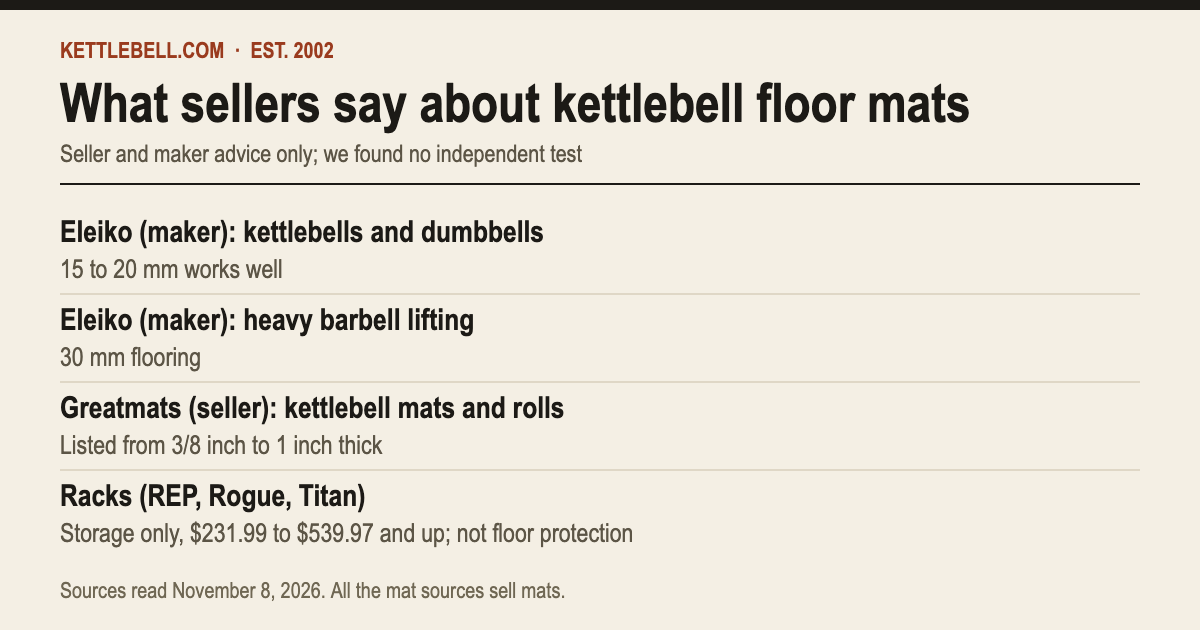
Quick answer: put a rubber mat or interlocking tiles under the area where you swing, press and might drop a bell; makers suggest 15 to 20 mm for kettlebells and 30 mm for heavy barbell lifting. For storage, a rack gets bells off the floor, but you do not need one until the bells are in your way.
Do you need a mat under your kettlebells?
Probably, if you train indoors on a floor you care about. Greatmats, a flooring seller, notes that a kettlebell’s compact shape puts a lot of weight into a small space, which raises the risk of damaging whatever it is dropped on, and recommends a heavy-duty mat for protection and footing. Eleiko, a barbell and flooring maker, says the floor protects your home and dampens noise. Both sell mats, so read this as sellers’ advice, not a test. A garage with a concrete slab may need less protection than a wood or tile floor upstairs, but we found no source that tells you how much less.
How thick should a kettlebell mat be?
| Source | What it says or sells |
|---|---|
| Eleiko (maker) | 15 to 20 mm “works well” for bench training, dumbbells and kettlebells; 30 mm for heavy barbell lifting; its rubber mat tiles are 30 mm thick and measure 1 x 0.5 m |
| Greatmats (seller) | Lists rolls and tiles for kettlebells from 3/8 inch to 1 inch thick, including a 14.5 mm roll with a 5-year warranty |
A 15 to 20 mm mat is therefore the most specific figure we found for kettlebells, and sellers sell thicker mats too. The thickness that protects your floor depends on the bell’s weight, how far it falls and what is underneath, and none of the sources we read tested that.
Setting up a whole space? See best kettlebells for a home gym and how much a kettlebell costs.
Mat, soft bell or rack: which protects your floor?
- A mat protects the floor under the whole work area, including the spot where you set a bell down.
- A soft or vinyl-coated bell is sold by its makers as quieter and gentler on floors; we found no independent test. See soft kettlebells.
- A rack stores bells off the floor and keeps them in one place, but it is storage, not floor protection.
How to store kettlebells: racks
A rack gets bells off the floor. These are the racks we read about on the makers’ own pages (prices and sizes from November 8, 2026; see kettlebell sets and racks for the full comparison).
| Rack | Price | What the maker lists |
|---|---|---|
| REP Kettlebell Storage Rack | $231.99 | Two tiers, 1,000 lb capacity, shelf 58.75 in by 9.75 in |
| Rogue Universal Storage System 2.0 | $395.00 | Two or three tiers, 14 in deep tray, casters and rubber feet included |
| Titan Elite Series Mass Storage System | From $539.97 | Two or three tiers, up to 1,000 lb per shelf, wheels optional |
Rack safety, including moving a loaded rack, bolting it down and checking shelf depth, is covered in kettlebell sets and racks. A loaded rack is heavy, so if you are unsure your floor can carry it, ask a builder.
What we could not find
- No independent test of mats. We found only seller and maker advice, which sells the product it recommends.
- No dependable drop-damage figures. One seller article says a dropped bell can crack concrete or dent wood, but we could not trace that to a test, so we do not repeat it as fact.
- No source on how much storage a home needs. Start with the bells you own.
Questions people ask
Do I need a mat for kettlebells?
Sellers recommend one under the work area to protect the floor and give you footing. We found no independent test, and how much you need depends on your floor and your bells.
How thick should a kettlebell mat be?
Makers suggest 15 to 20 mm for kettlebells and 30 mm for heavy barbell lifting. Kettlebell mats and rolls run from 3/8 inch to 1 inch thick.
How do you protect floors from kettlebells?
The common advice is a rubber mat or interlocking tiles under the work area. A soft or vinyl-coated bell is another option makers sell for quieter, gentler use; see soft kettlebells.
How should I store kettlebells at home?
A rack gets bells off the floor. It is storage, not training equipment, and bells can sit on a mat without one; see sets and racks.
Read next
Sources and method
This guide is research-based. We read the sellers’ and makers’ own pages on November 8, 2026 and have tested nothing. All of the flooring sources sell mats. Some links may be affiliate links; if you buy through one it costs you nothing extra and helps support the site. See our affiliate disclosure.
- Eleiko, “Home gym flooring: the hidden hero of your home gym”, read November 8, 2026.
- Greatmats, “What Are The Best Floor Mats for Kettlebells?” (modified November 2025), read November 8, 2026.
- Rack facts: REP, Rogue and Titan product pages as cited in our sets and racks sources.