Guide
Competition Kettlebell vs Cast Iron: Which One to Buy?
Competition vs cast iron kettlebell: two bells can both say “16 kg” and feel very different in your hands. The weight is the same. The shape is not.
Quick answer: A competition bell keeps one size and one handle width at every weight (Rogue: 33 mm). A cast iron bell grows with the weight and its handle gets thicker (Rogue: about 30 to 44 mm). Material varies by maker, so read the spec.
The one big difference: size
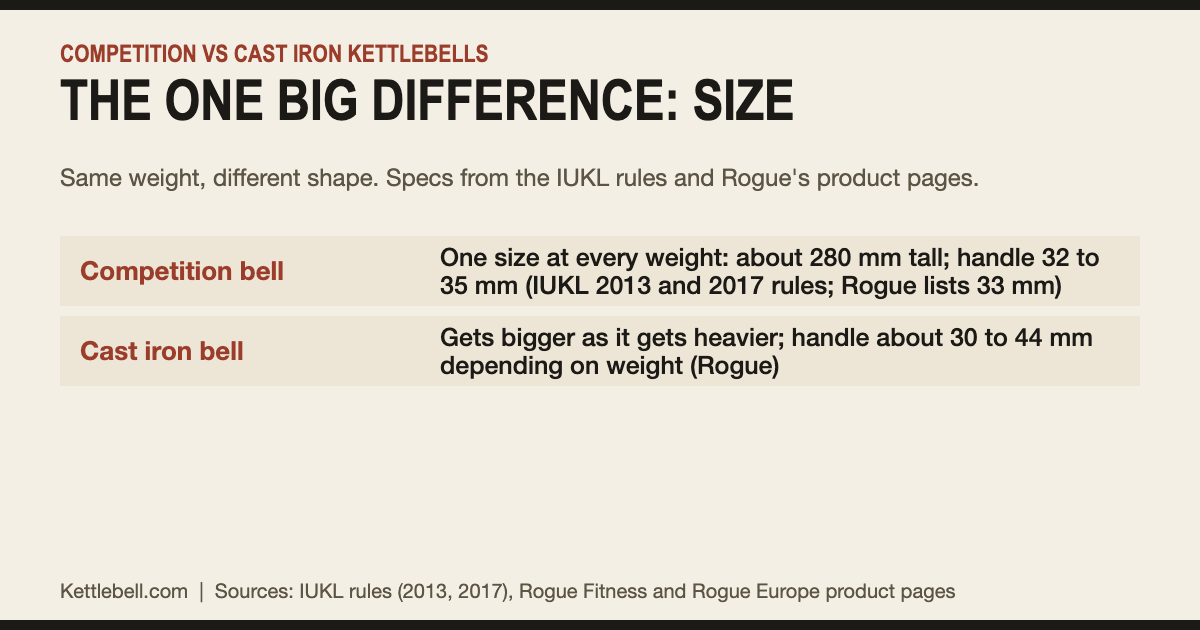
A competition bell is built to one standard size, whatever the weight. Rogue’s competition bell, for example, is 282 mm tall with a 208 mm wide body and the same 33 mm handle from 8 kg all the way to 48 kg. Go up in weight and the bell does not get bigger.
A cast iron bell is cast solid, so a heavier bell is a bigger lump of iron. Rogue’s cast iron bells list handle widths from 1.19 to 1.73 inches (about 30 to 44 mm) depending on weight, and the height changes with weight too. You get a thicker handle on the heavy bells and a thinner one on the light ones.
The specs side by side, as read on November 7, 2026 (sources below):
| Spec | Rogue competition bell | Rogue cast iron bell | IUKL competition rules |
|---|---|---|---|
| Weights | 8 to 48 kg | 4 to 92 kg (9 to 203 lb) | A colour for each weight (2013) |
| Height | 282 mm (11.1 in), same at every weight | Varies with weight | 280 mm (2013 and 2017) |
| Body width | 208 mm (8.19 in), same at every weight | Not listed on the page we read | 210 mm (2013 and 2017) |
| Handle diameter | 33 mm, same at every weight | 1.19 to 1.73 in (about 30 to 44 mm), thicker on heavier bells | 35 mm (2013); 32 mm (2017) |
| Weight tolerance | Plus or minus 1 percent | Not listed on the page we read | 100 grams (2013) |
| Material | Solid-piece cast iron, matte black powdercoat | Ductile iron | Not covered in the pages we read |
What that changes in practice
- Handle: the competition handle stays the same width, so your grip and hand position stay familiar as you move up. On cast iron, a heavier bell has a thicker handle, which some people find harder to hold for high reps. That is the usual claim from sellers, and the numbers (about 30 to 44 mm vs a fixed 33 mm) fit it. How it feels for you is personal.
- Shape against your forearm: a competition bell has the same shape each time, so it should sit the same way in the rack position as you change weights. Rogue’s competition bell has four contoured flats and a smooth finish that, Rogue says, cut friction in presses, cleans and snatches.
- Choice of weights: Rogue’s competition bells run from 8 to 48 kg and its cast iron bells from 4 to 92 kg. We left prices out on purpose. They change, and we only quote live prices with a date.
- Rules: if you ever want to compete, you need a competition bell. The IUKL 2013 rules list 280 mm tall, a 210 mm body and a 35 mm handle, with a colour for each weight. Its 2017 rules list a 32 mm handle, so the standard has moved. Rogue’s competition bell uses 33 mm.
Material is not a rule. Rogue’s competition bell is solid-piece cast iron, so do not assume “competition” means steel. Read the maker spec for material, handle diameter and weight tolerance (Rogue’s is plus or minus 1 percent; the IUKL 2013 rules allow 100 grams). Weighing a kettlebell against a dumbbell instead? See how to choose.
Which one to buy: competition vs cast iron kettlebell
- Cast iron if you want a wide range of weights, or you mainly want a bell for general training at home.
- Competition if you plan to do a lot of reps in swings, cleans or snatches, if you might compete, or if you want the same feel as you add weight.
- Not sure? Start with one bell in the weight range we cover in our guide on what weight to start with. You can add a second type later.
Questions people ask
Do I need a competition kettlebell?
Only if you plan to compete or want the same shape and handle at every weight. A cast iron bell works for general training.
Are competition kettlebells made of steel?
Not always. Rogue’s competition bell is solid-piece cast iron. Check each maker.
What size is a competition kettlebell?
The IUKL 2013 rules list 280 mm tall, a 210 mm body and a 35 mm handle; the 2017 rules list a 32 mm handle. Rogue’s bell is 282 mm, 208 mm and 33 mm.
Read next
- What weight kettlebell should you start with?
- Kettlebell weight chart
- Adjustable vs fixed kettlebells
- Soft kettlebells
Sources and method
- Rogue Competition Kettlebells (Rogue Europe site), read Nov 7, 2026: 8 to 48 kg, 282 mm (11.1″) tall, 208 mm (8.19″) wide, 5.5″ base, 33 mm handle, matte black powdercoat, four contoured flats, same dimensions at every weight.
- Rogue Ductile Iron Kettlebells (roguefitness.com), read Nov 7, 2026: handle diameter 1.19″ to 1.73″ depending on weight, height varies by weight, ductile iron, 4 kg (9 lb) up to 92 kg (203 lb).
- IUKL International Rules and Regulations for Competitions, 2013 (280 mm, 210 mm body, 35 mm handle, colours) and 2017 (280 mm, 210 mm body, 32 mm handle), both read Nov 7, 2026.
- REP Fitness kettlebell range page, read Nov 7, 2026: iron cast bells 4 to 48 kg, colour-coded handles.
- We read one maker for each type.