Guide
Kettlebell Weight Chart: kg, lb, Pood and Colours
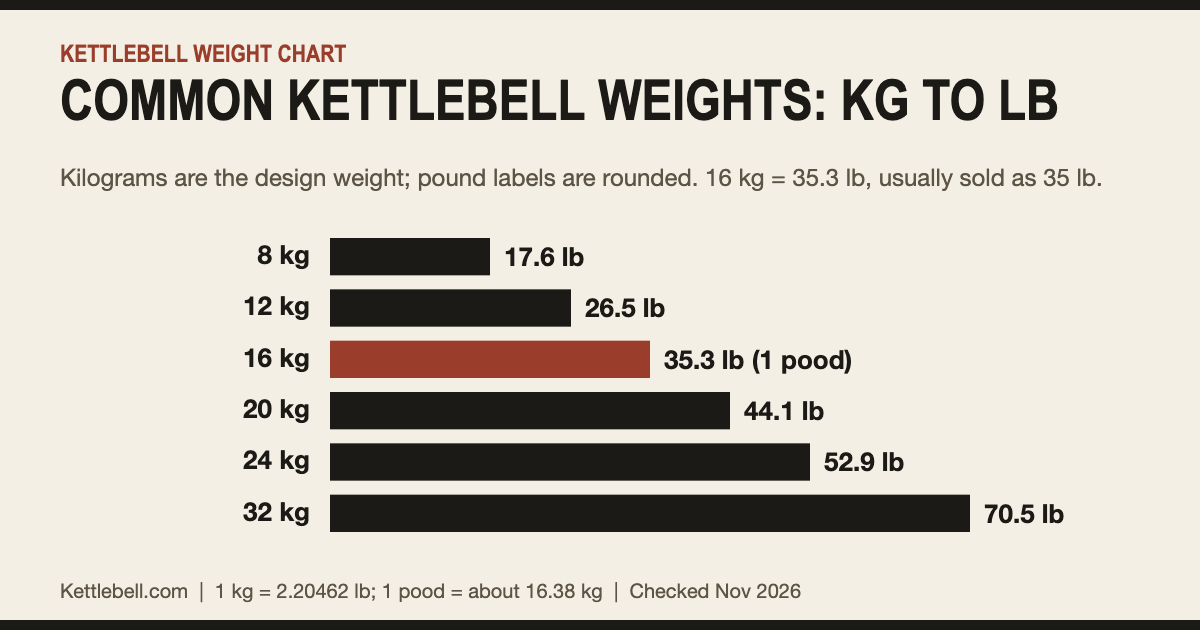
Kettlebells are sold in kilograms almost everywhere, and in pounds in the US. Old Russian bells are marked in pood. Here is the whole thing in one table.
Quick answer: 16 kg is 35.3 lb, about one pood. 24 kg is 52.9 lb. Competition bells follow a colour code (16 kg is yellow, 24 kg green), but home bells often do not, so read the weight stamped on the bell.
| Kilograms | Pounds | Pood |
|---|---|---|
| 4 kg | 8.8 lb | 0.24 |
| 6 kg | 13.2 lb | 0.37 |
| 8 kg | 17.6 lb | 0.49 |
| 10 kg | 22.0 lb | 0.61 |
| 12 kg | 26.5 lb | 0.73 |
| 14 kg | 30.9 lb | 0.85 |
| 16 kg | 35.3 lb | 0.98 |
| 18 kg | 39.7 lb | 1.10 |
| 20 kg | 44.1 lb | 1.22 |
| 22 kg | 48.5 lb | 1.34 |
| 24 kg | 52.9 lb | 1.47 |
| 28 kg | 61.7 lb | 1.71 |
| 32 kg | 70.5 lb | 1.95 |
| 36 kg | 79.4 lb | 2.20 |
| 40 kg | 88.2 lb | 2.44 |
| 48 kg | 105.8 lb | 2.93 |
Pounds and pood are rounded. We worked them out from two numbers: 1 kg is 2.20462 lb, and 1 pood is about 16.38 kg.
Kettlebell weights in pounds: pounds to kilograms
Shopping in pounds? Start here. Each row converts a pound weight to kilograms (1 lb is 0.45359 kg, rounded to 0.1 kg).
| Pounds | Kilograms |
|---|---|
| 10 lb | 4.5 kg |
| 15 lb | 6.8 kg |
| 20 lb | 9.1 kg |
| 25 lb | 11.3 kg |
| 30 lb | 13.6 kg |
| 35 lb | 15.9 kg |
| 40 lb | 18.1 kg |
| 45 lb | 20.4 kg |
| 50 lb | 22.7 kg |
| 60 lb | 27.2 kg |
| 70 lb | 31.8 kg |
| 80 lb | 36.3 kg |
| 90 lb | 40.8 kg |
| 100 lb | 45.4 kg |
The kilogram number is a conversion, not always the weight the bell was made around. A bell sold as 35 lb is usually the 16 kg bell (35.3 lb), and a 53 lb bell is usually the 24 kg one. If a listing shows both, trust the kilogram figure.
The usual starting sizes work out to 8, 12 and 16 kg (17.6, 26.5 and 35.3 lb) for an average-strength woman, and 16 and 24 kg (35.3 and 52.9 lb) for an average-strength man. See what weight kettlebell to start with for the details and the cautions. The same sizes by strength level are in kettlebell weight for women and men. Bells of 24 kg and up are covered in heavy kettlebells.
Why shop labels say 35 lb, not 35.3
Makers round. A “35 lb” bell is usually the 16 kg bell. Choosing a first bell? Start with buying your first kettlebell. A “53 lb” bell is the 24 kg one. When a listing gives only pounds, check whether the kilogram weight is shown too, because that is the number the bell was designed around.
What is a pood?
A pood is an old Russian unit, 40 Russian pounds, or about 16.38 kg. The 16 kg bell is the “one pood” bell, near enough, and traditional bells came in pood multiples. You will still see it on Russian-style bells and in girevoy (kettlebell sport) talk.
Colours: the sport has a code, home bells often do not
In kettlebell sport, competition bells are colour coded by weight so judges and athletes can tell sizes apart. The International Union of Kettlebell Lifting (IUKL) 2013 rules list it like this:
| Weight | Colour |
|---|---|
| 8 kg | pink |
| 12 kg | blue |
| 16 kg | yellow |
| 20 kg | purple |
| 24 kg | green |
| 28 kg | orange |
| 32 kg | red |
| 40 kg | bronze |
The same rules give the size of a competition bell: 280 mm tall, a 210 mm body and a 35 mm handle (the 2017 rules list 32 mm), with the weight allowed to be off by no more than 100 grams. Other bodies differ in the details, and cast iron bells for home gyms often use other colours or none. So treat colour as a hint, then read the weight stamped on the bell. Never buy on colour alone. Soft and vinyl-coated bells are a separate case: see how soft, vinyl-coated and plain cast iron bells compare.
Questions people ask
How many pounds is a 16 kg kettlebell?
35.3 lb (16 kg times 2.20462). Sellers usually round it to 35 lb.
How many kilograms is a pood?
About 16.38 kg. StrongFirst treats one pood as 16 kg, about 35 lb, which is the everyday gym meaning.
Are kettlebell colours standard?
In kettlebell sport, yes: the IUKL 2013 rules list a colour for each competition weight (8 kg pink up to 40 kg bronze). Home gym bells use their own colours or none.
What sizes do kettlebells come in?
When people say size they usually mean weight, and the table above lists the common weights in kilograms, pounds and pood. The physical size (height and handle thickness) depends on the maker and on whether the bell is competition style or cast iron. See competition vs cast iron kettlebells.
How many kilograms is a 35 lb kettlebell?
About 15.9 kg. A bell sold as 35 lb is usually the 16 kg bell, which is 35.3 lb.
How heavy is a 50 lb kettlebell in kilograms?
About 22.7 kg. Common metric bells come close on either side: 22 kg is 48.5 lb and 24 kg is 52.9 lb.
Read next
- What weight kettlebell should you start with?
- Competition vs cast iron kettlebells
- Adjustable vs fixed kettlebells
- 12 kg vs 16 kg kettlebell: which to buy first
- Kettlebell weight for women and men
- Heavy kettlebells: 24 kg, 32 kg and up
Sources and method
- Conversion: 1 lb is exactly 0.45359237 kg by definition. We computed the table values and rounded them.
- Pood: StrongFirst’s kettlebell page says one pood equals 16 kilograms, approximately 35 pounds (strongfirst.com, read Nov 7, 2026). Converter and history sites give about 16.38 kg, 40 Russian funty (checked Nov 7, 2026).
- Colours and size: International Union of Kettlebell Lifting, International Rules and Regulations for Competitions (2013), sections 3.2 and 3.3, read Nov 7, 2026.