From the Archives:
KB Power! Part II: The Kettlebell Power Snatch
This archived article was originally published in 2006 and is kept online for archival purposes. Facts, advice, prices, offers and links may be out of date. For current, sourced advice, see our newer guides. The content below may also be incomplete, as some of the original site was lost.
By John Davies
Page: 1 2 3
If you’re new here, you may want to subscribe to my RSS feed. Thanks for visiting!
Master The Technically Challenging Power Snatch
In continuation with the theme of learning the kettlebell lifts lets consider what many consider as the most important of movements and certainly the most challenging technically; the Power Snatch.
The kb Snatch again is a bit of a misnomer as it is truthfully a unique alternative to its Olympic lifting cousin. Additionally, within Renegade style training, barbell movements such as the Close Grip Snatch or the One-hand Snatch will carryover to the kb variation where you seemingly are punching through the bell as it approaches the highest point of the lift. Again it is important to recall the Renegade Concepts of Training movement is trained and not muscles and teaching the body to move in a single, harmonious action.
Now before you complicate this lift or learn it incorrectly, let’s start the right way the first time out of the chute. First and foremost, please note while some make the kb snatch appear to be complicated, it really isn’t when you follow a simple step-by-step guideline.
The development of the kettlebell Power Snatch is relatively simple, with two very distinct methods of performing but with easy to follow keys. First the kb Snatch is broken into (a) swing and (b) pull-through styles. From experience I find the pull-through style preferable because it (generally) will place less strain on joints as the movement pattern is more energy efficient and safer. However there that being said both methods should be understood as they tend to compliment one another. In teaching the kettlebell snatch, two unique lifts will assist the athlete tremendously in learning the necessary timing and feel (a) Clean & Catch and (b) Renegade Squat-Pull.
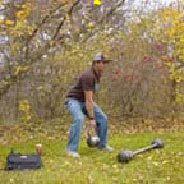
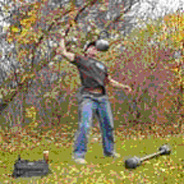
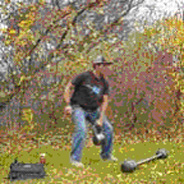
Learn more from John Davies about the Clean & Catch (pictured here) in KB Power! Part 1: The Kettlebell Power Clean.
Once again, as with the kettlebell Power Clean, the Clean & Catch will assist in the teaching of this as the incumbent learns to pull upward tight to the body with a violent thrusting of the hips forward. In the Clean & Catch the hips are shot forward and as the bell reaches sternum level, is released and the opposite hand (which starts the movement behind-the-back) turns and catch’s it heading downward. This exercise is a perfect display of many of the aforementioned concepts of movement generation that ultimately lead to the goal of projecting, accepting and re-directing maximal force. However please note this lift is extremely dangerous and should never be attempted without a skilled coach of this lift present.
The Renegade Squat Pull
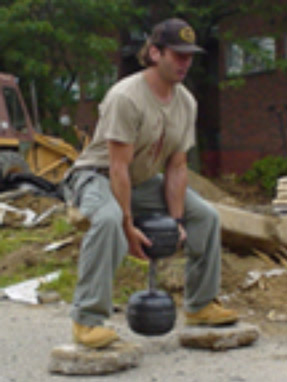
Stage 1:
From standing position (note feet may be supported to “extend” range of movement), push buttocks back and allow arms to hang low along inner thighs. At base of lift, back should be in neutral position.
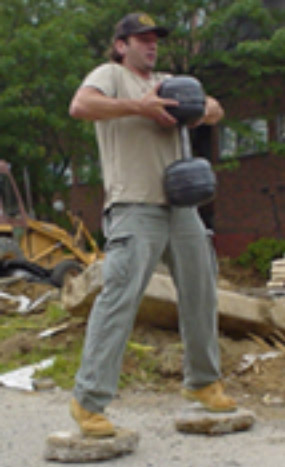
Stage 2
To complete lift drive off ground by thrusting hips forward and lifting weight with hands tight to body and extending shoulders, elbows high.
Turning to the Power Snatch, the benefits of both of these lifts will assist greatly in performing the pull-through variation of the kettlebell Power Snatch. To maximize the benefit of this lift, we have coupled it with wearing the Xvest. The added resistance of the Xvest distributes the load on the body as opposed to merely the kettlebell. By doing such the incumbent, when performing with proper postural alignment will actually improve the training effect.
The Renegade Power Snatch
(A photograph that belongs here was not preserved by the Wayback Machine.)
Stage 1:
In-fact this should be corrected as a Power Hang from the “hang position”. Prior to this stage, the incumbent is upright position, exhibiting perfect posture and then drops by pushing the buttocks back. This will place the back in a strong “neutral” back position of roughly 45 degrees.
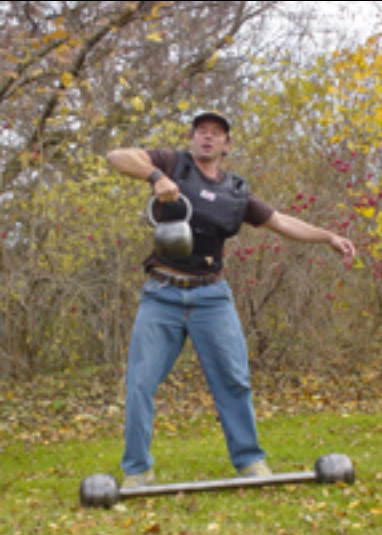
Stage 2
In this position, the lift is well underway with the hips thrusting forward and the athlete beginning to come to standing position on balls of feet. The shoulders, the traps, vigorously thrust upward with the elbow pulling high and the bell is pulled relatively close to the body. At this stage the speed of the movement has caused a similar “unloading” momentum as with classic barbell lifts.
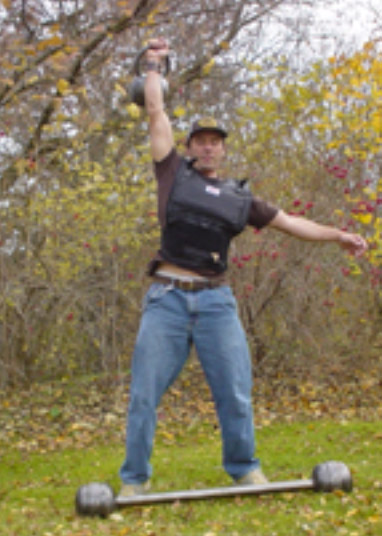
Stage 3
As you progress from stage 2 to 3 photos it is important to note how the bell stays tight to the body. As the bell extends beyond sternum to shoulder level it is “unloading” and momentum carries the bell upward. The elbow shoots under and “punches” through the bell, extending the arm completely upright as the bell softly comes to contact against the forearm, above the head. Done properly the bell should be resting behind the head at the top of the lift.
About the author
John Davies, Kettlebell.com Senior Staff Writer, is the founder of the “Renegade world” of companies, including the well known websites renegadestyle.com and renegadetraining.com. A prolific writer, he has published five books and has another two slated for release in the next twelve months. In addition to this, John has written over 850 articles on a wide variety of topics, as well as appeared in a wide selection of DVDs. He serves as the spokesperson for a variety of top-flight companies and has established the "Renegade" brand and team members as a leader in the profession and synonymous with lasting quality and ethics.
When John isn’t writing or training, he’s paddling out into the surf or thrashing down a mountain of fresh powder.
One photograph (the first stage of the Renegade Power Snatch) was not preserved by the Wayback Machine. The other photographs and pages 2 and 3 were recovered from an earlier 2007 capture.