Guide
Kettlebell Exercises for Beginners: Three Moves
The kettlebell swing, the suitcase carry and the halo are three beginner-friendly moves. This page explains in plain words how each one works. It is not a coaching programme: it gives no sets, reps or schedule, and a written description cannot replace a qualified coach watching you move. This is general information, not medical advice.
Quick answer: start with a light bell, learn the swing’s hip hinge first (the strength comes from the legs and hips, not the shoulders), and consider an in-person lesson from a certified coach before you add weight.
Before you start
- Pick a light bell. StrongFirst says kettlebells feel heavier than the number on them and not to exceed its starting sizes; see what weight kettlebell to start with.
- Clear the space and check the floor. Swings need room in every direction. See kettlebell floor protection and storage.
- Ask first if needed. Ask a doctor or physical therapist before you start if you have an injury, a heart, blood pressure or joint condition, or you are pregnant. We cannot tell you what is safe for you.
How to do the kettlebell swing
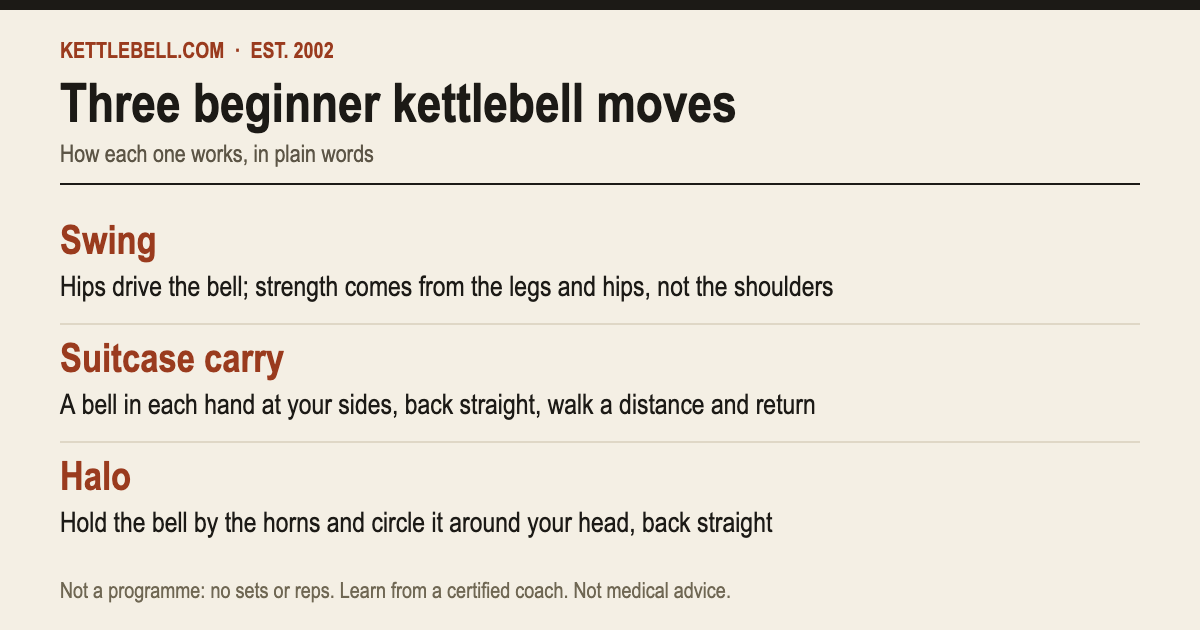
Stand with your feet shoulder-width apart and your knees slightly bent, hold the bell in both hands with your palms facing down and squeeze the handle. With a straight back, sink back into the hips to pull the bell between your legs, then quickly push your hips forward to swing it up in front of you to about chest height. Let it come back down between your legs as you sink into the hips again for the next repetition.
The key tip: the strength to move the weight should come from the legs and hips, not the shoulders. There is also a single-arm swing, which uses one hand in the same pattern; learn the two-handed version first. For the research on swings, see kettlebell benefits.
How to do the suitcase carry
Hold one bell in each hand with a firm palms-down grip, with the arms resting at your sides so the bells sit next to your hips. Keeping your back straight, walk a set distance, then turn around and walk back. This version uses two bells; our buying guide explains why one bell is enough to begin with other moves.
How to do the halo
Stand with your feet about shoulder-width apart and hold the bell by its horns in front of your chest. Keeping your back straight, move the bell over one shoulder, around behind your head and back to the chest over the other shoulder, then repeat in the opposite direction. The horns are the two upright sides of the handle that join it to the bell.
What a written guide cannot tell you
- How much weight, how many repetitions or how often. We give none of that. A coach can set it for you.
- How your own form looks. A written description cannot show whether your back is straight or your hips are leading. Film yourself from the side, or book a lesson.
- The goblet squat and other common first moves. We have not covered them here yet.
Questions people ask
What are the best kettlebell exercises for beginners?
The swing, suitcase carry and halo are three good places to start. We cannot rank them for you; a certified coach can pick moves that suit your body and goals.
How do you do a kettlebell swing?
It is a hip movement: sink back into the hips to pull the bell between your legs, then quickly push the hips forward to swing it to chest height, with the strength coming from the legs and hips rather than the shoulders.
What weight kettlebell should a beginner use for swings?
StrongFirst’s starting sizes are 8, 12 and 16 kg for an average-strength woman and 16 and 24 kg for an average-strength man, and it says to start lighter than you think; see our starter weight guide.
Can I learn kettlebell exercises from a website?
A written description can show the pattern but not your form. We recommend a lesson from a certified coach before adding weight.
Read next
- What weight kettlebell should you start with?
- Kettlebell benefits: what the research shows
- Buying your first kettlebell
Sources and method
This guide is research-based. We read the ACE pages below on November 8, 2026 and paraphrased them; we did not test the moves and a qualified coach or clinician has yet to review this page. Some links may be affiliate links; if you buy through one it costs you nothing extra and helps support the site. See our affiliate disclosure.
- ACE, “Swing” and “Single Arm Swing”, Exercise Library, read November 8, 2026.
- ACE, “Suitcase Carry”, Exercise Library, read November 8, 2026.
- ACE, “Halo”, Exercise Library, read November 8, 2026.
- StrongFirst starting sizes, as summarised in our starter weight guide.