Guide
Kettlebell Benefits: What the Research Shows
Kettlebell training has real research behind some claims and none behind others. Small trials found strength gains, less neck and back pain in one group of office workers, and better balance reactions. A 2019 review of 99 publications found the effects were trivial to small and the confidence in them low. This is general information, not medical advice.
Quick answer: on the evidence we found, kettlebell training can build strength and may ease some pain, but it is not shown to beat other strength training, and we found no trial showing it improves aerobic fitness or burns fat better than other exercise.
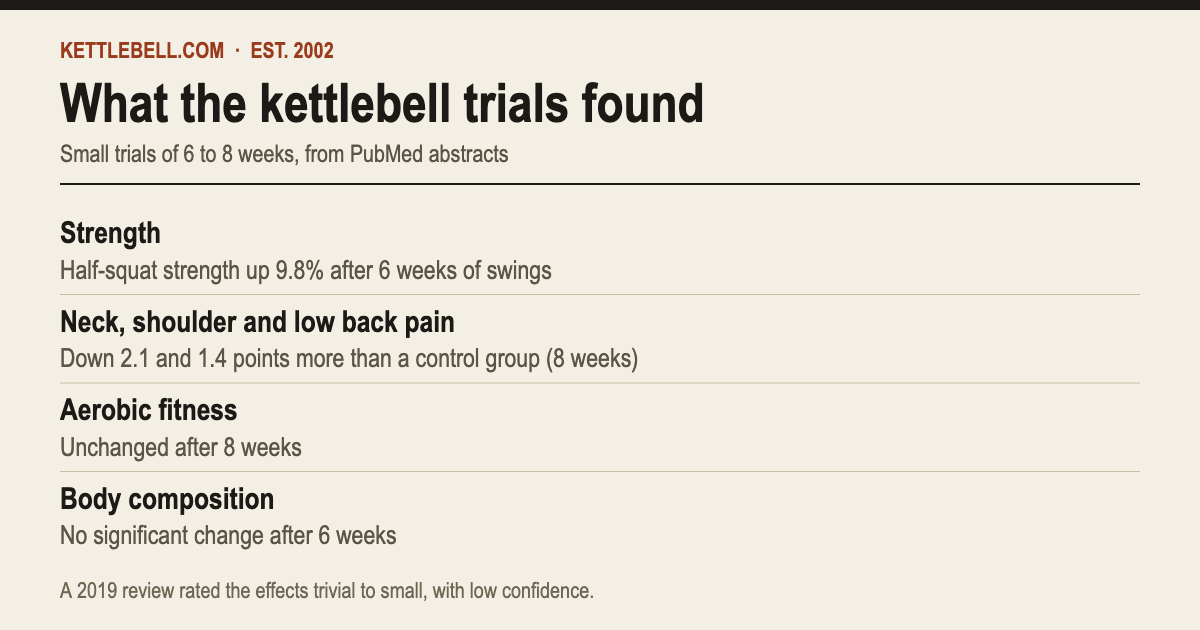
What the research says about kettlebell benefits
The best overview we found is a 2019 scoping review of kettlebell training (a scoping review maps the evidence rather than weighing it up). It identified 99 publications and concluded that effect sizes were typically trivial to small, that the longitudinal studies were mostly underpowered and of low methodological quality, and that confidence in the reported effects was low to very low. Its authors called the case for kettlebells improving physical function “weak” and asked for better trials. Everything below should be read with that in mind.
| Study | Who, and for how long | What the abstract reports |
|---|---|---|
| 2012 trial: swings vs jump squats | 21 healthy men aged 18 to 27, kettlebell swings twice a week for 6 weeks | Half-squat strength rose 9.8% and jump height 19.8%, with no significant difference from jump-squat training |
| 2012 trial: weightlifting vs kettlebell | 30 healthy men, 2 sessions a week for 6 weeks | Both groups gained strength and power, but weightlifting gained more strength than kettlebells; no body composition change in either |
| 2011 trial: pain and fitness | 40 adults from jobs with a high rate of pain (mean age 44, 85% women), 3 times a week for 8 weeks, against a control group | Neck and shoulder pain fell 2.1 points and low back pain 1.4 points (0 to 10 scale) more than in the control group; trunk extensor strength rose; aerobic fitness did not change |
| 2013 trial: balance reactions | The same 40 adults | Stopping time after a sudden push was 109 ms shorter; the jump height gain was not significantly different from control |
| 2018 trial: older women with sarcopenia | 33 women aged 65 to 75, 60-minute sessions twice a week for 8 weeks, against a control group | Higher grip strength, back strength and a sarcopenia index than the control group; muscle mass fell in the control group |
Two of these rows come from the same 40 people, so they are not two separate confirmations. All the trials are small, short (6 to 8 weeks) and tested mostly healthy adults or, in two cases, specific groups.
Kettlebell benefits for strength
Short kettlebell programmes raised strength in healthy adults. They did not clearly beat the alternative: in one trial swings matched jump squats, and in another weightlifting produced bigger strength gains than kettlebells. So the supported claim is that kettlebells are an effective way to build strength, not a better one.
Kettlebell benefits for back and neck pain
The one randomised trial we found on pain used 40 adults from jobs with high rates of pain, and the training group’s neck, shoulder and low back pain fell by more than the control group’s. It was a single-blind trial of 8 weeks, and the people were mostly women in a worksite programme. It does not show that kettlebells treat back pain in general. If you have pain or an injury, ask a doctor or physical therapist before you start, and do not use a kettlebell as treatment.
Kettlebell benefits for balance and older adults
The same worksite trial found quicker recovery after a sudden push. A separate trial of 33 older women with sarcopenia (age-related muscle loss) found gains in grip and back strength after 8 weeks. Both are small trials in specific groups.
What kettlebell training has not been shown to do
- Improve aerobic fitness. The 2011 trial reported aerobic fitness unchanged after 8 weeks. The ACE-sponsored study often quoted for calorie burn measured one very hard snatch workout in 10 experienced users and did not compare other exercise; see kettlebell vs dumbbell.
- Change body composition. The weightlifting comparison found no significant body composition change in either group.
- Beat other strength training. No trial we found showed kettlebells winning over weightlifting or jump squats on strength.
- Work long term. The trials ran 6 to 8 weeks. We found nothing longer.
How kettlebell training fits into a weekly routine
The CDC’s guidance for adults is at least 150 minutes of moderate aerobic activity a week plus muscle-strengthening activity on 2 or more days that works all the major muscle groups. It does not name kettlebells. The trials above used two to three sessions a week for 6 to 8 weeks, so that is the range the evidence actually covers. A kettlebell can be one way to do the strength days; it does not replace the aerobic part. Start lighter than you think and learn technique first; see what weight kettlebell to start with, and buying your first kettlebell if you do not own one yet. If you are setting up a space for it, see best kettlebells for a home gym and how much a kettlebell costs.
Ask a doctor or physical therapist first if you have an injury, a heart, blood pressure or joint condition, or you are pregnant. We cannot tell you what is safe for you.
Questions people ask
What are the benefits of kettlebell training?
In small trials, kettlebell training raised strength, reduced neck and low back pain in one group of workers and improved balance reactions. A 2019 review rated the overall effects trivial to small and the confidence low to very low.
Are kettlebells good for weight loss?
We found no trial showing kettlebells cause fat loss. The one body composition comparison we read found no significant change in either group after 6 weeks.
Are kettlebells better than dumbbells or weightlifting?
Not on the evidence we found. In one trial swings matched jump squats for strength, and in another weightlifting gained more strength than kettlebells.
How often should you do kettlebell training?
The trials we read used two to three sessions a week. The CDC advises muscle-strengthening activity on at least 2 days a week for adults, and does not name a tool.
Do kettlebells help back pain?
One 8-week trial in 40 workers found less neck, shoulder and low back pain than a control group. It does not show kettlebells treat back pain; ask a doctor or physical therapist if you have pain.
Read next
- Buying your first kettlebell
- What weight kettlebell should you start with?
- Kettlebell vs dumbbell
- Kettlebell exercises for beginners
Sources and method
This guide is research-based. We read the abstracts of the studies below on PubMed on November 8, 2026, and did not read the full papers, so details beyond the abstracts are not covered. A qualified coach or clinician has yet to review this page. We searched PubMed for systematic reviews and meta-analyses of kettlebell training and found none; the 2019 scoping review is the broadest review we found.
- Scoping review: “Kettlebell training in clinical practice: a scoping review”, BMC Sports Science, Medicine and Rehabilitation, 2019.
- Swings vs jump squats: “Kettlebell swing training improves maximal and explosive strength”, Journal of Strength and Conditioning Research, 2012.
- Weightlifting vs kettlebell: “Effects of weightlifting vs. kettlebell training on vertical jump, strength, and body composition”, Journal of Strength and Conditioning Research, 2012.
- Pain and fitness trial: “Kettlebell training for musculoskeletal and cardiovascular health: a randomized controlled trial”, Scandinavian Journal of Work, Environment and Health, 2011.
- Balance trial: “Effects of kettlebell training on postural coordination and jump performance: a randomized controlled trial”, Journal of Strength and Conditioning Research, 2013.
- Older women with sarcopenia: “Effects of 8-week kettlebell training on body composition, muscle strength, pulmonary function, and chronic low-grade inflammation in elderly women with sarcopenia”, Experimental Gerontology, 2018.
- CDC, “Adult Activity: An Overview”, read November 8, 2026.
- ACE FitnessMatters, January/February 2010 article on the ACE-sponsored kettlebell study, as summarised in our kettlebell vs dumbbell guide.